Welcome to Shenzhen Sunshine Good Electronics Co.,Ltd.!


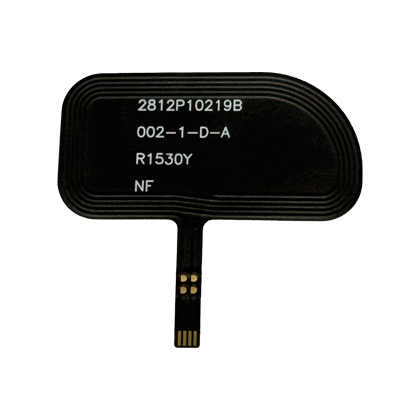
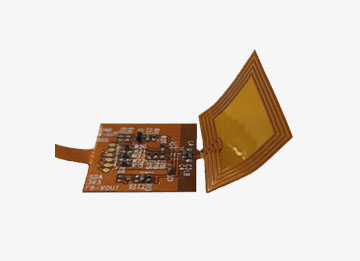
The NFC Antenna PCB for the passive E-ink phone case is the core component enabling "battery-free wireless power and data transmission." It is essentially an NFC coil (typically manufactured using either enameled wire winding or FPCB processes; this product uses the FPCB process) integrated precisely within the phone case. Based on 13.56MHz RF technology, it forms an electromagnetic coupling with the phone's NFC module: on one hand, when the phone is touched, it wirelessly powers the E-ink screen and control circuit inside the phone case via electromagnetic induction (eliminating the need for an extra battery); on the other hand, it simultaneously enables bidirectional data transmission (e.g., images, text commands sent from the phone) to drive the E-ink screen to refresh its content. Its design must balance miniaturization (to fit the phone case's thin structure), high coupling efficiency (ensuring stable energy and signal transfer), and anti-interference capability (avoiding conflicts with other phone wireless modules).



Product Overview
I. Product Definition
The NFC Antenna PCB for the passive E-ink phone case is the core component enabling "battery-free wireless power and data transmission." It is essentially an NFC coil (typically manufactured using either enameled wire winding or FPCB processes; this product uses the FPCB process) integrated precisely within the phone case. Based on 13.56MHz RF technology, it forms an electromagnetic coupling with the phone's NFC module: on one hand, when the phone is touched, it wirelessly powers the E-ink screen and control circuit inside the phone case via electromagnetic induction (eliminating the need for an extra battery); on the other hand, it simultaneously enables bidirectional data transmission (e.g., images, text commands sent from the phone) to drive the E-ink screen to refresh its content. Its design must balance miniaturization (to fit the phone case's thin structure), high coupling efficiency (ensuring stable energy and signal transfer), and anti-interference capability (avoiding conflicts with other phone wireless modules).
II. Product Characteristics
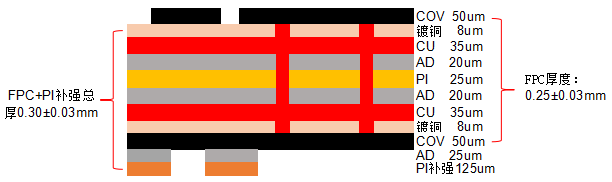
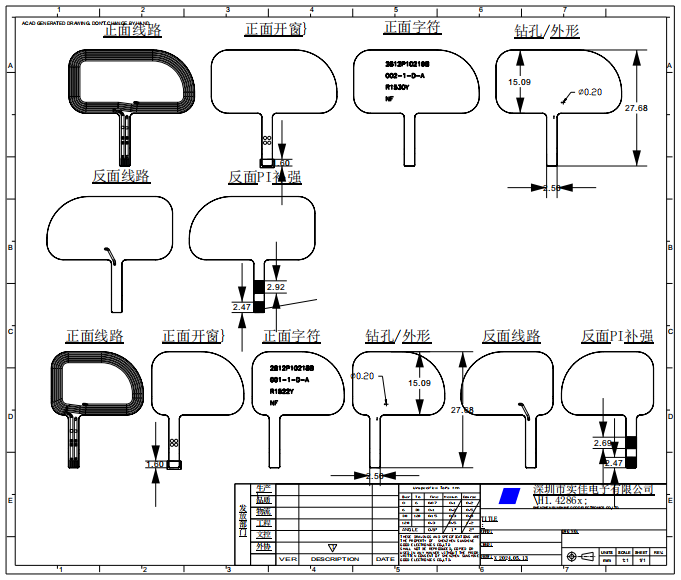
It uses a flexible PI-based FCCL as the carrier. The planar coil (trace width accuracy ±10μm) is fabricated through standard PCB processes like drilling & desmearing, pattern transfer, plating, and etching. Vacuum lamination ensures tight bonding between the coil and the PI film, guaranteeing electromagnetic coupling efficiency. The process involves surface solder mask treatment (e.g., green/black oil coating) to reduce signal interference. Thermoforming is used to adapt to the phone case's curvature, balancing thinness (thickness ≤0.3mm) and bend resistance. Material selection prioritizes both high conductivity and flexibility, ultimately achieving high energy transfer efficiency, low loss (dielectric dissipation factor ≤0.001), and seamless integration with the phone case for aesthetics.
III. Product Technical Support
The technical support for the Passive E-ink Phone Case NFC Antenna PCB is evident in three key dimensions: materials, electromagnetic design, and precision manufacturing. Material-wise, it uses high conductivity (copper foil resistivity ≤1.7μΩ·cm), high flexibility (elongation at break ≥200%) PI or PET substrates, combined with low-loss dielectric materials (dielectric dissipation factor ≤0.001), ensuring efficient electromagnetic energy coupling and bend durability. Electromagnetic design involves optimizing the spiral/planar loop coil structure (trace width accuracy ±10μm) based on 13.56MHz RF principles, using simulation to achieve ≥70% electromagnetic induction energy harvesting efficiency upon phone contact, while ensuring stable bidirectional data transmission. Process-wise, it utilizes pattern transfer/plating/etching for coil fabrication, combined with vacuum lamination and thermoforming processes to achieve tight bonding between the coil and substrate (thickness ≤0.3mm) and adapt to the phone case curvature. This ultimately supports the realization of battery-free wireless power and long-lasting display functionality.
Characteristic Material Technologies:
Stable relative dielectric constant (Dk);
Low coefficient of thermal expansion (CTE);
Characteristic Process Technologies:
Controllable trace width;
Controllable trace spacing (clearance);
Component/Assembly Technologies:
LCR Parameter and Impedance Matching Technology (Design & Manufacturing);
Coupling Enhancement and Shape Optimization Technology (Design & Manufacturing);
Antenna Size and Structural Design Technology (Design & Manufacturing);
IV. Product Manufacturing Process
Double-sided FCCL + Coverlay cutting, CNC drilling, Black Hole (or similar direct metallization process), plating, pattern transfer, exposure & development & etching, lamination, pressing, testing, etc.
V. Key QC Processes
Hole wall thickness/plating quality control;
Conductor (Trace) Defect Testing;
LC Circuit Performance Testing;
VI. Product Test Report
"Passive E-ink Phone Case NFC Antenna RF Test Report";
VII. Direct Product Assembly: NFC E-ink Module
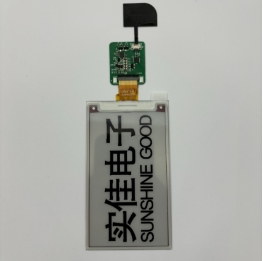
The NFC E-ink Module is an innovative hardware module that deeply integrates Near Field Communication (NFC) technology with E-ink displays. Its core technology lies in utilizing NFC wireless power harvesting for battery-free operation and leveraging the low-power characteristics of E-ink for long-lasting static content display. Core components include:
(1) NFC Antenna: Works with the NFC chip circuit to create the wireless communication RF field.
(2) NFC Module: Based on the core NFC chip, controlled by the main IC, handles data transceiving following phone NFC protocols.
(3) E-ink Display: Uses microcapsule electrophoretic technology, controlling black/white particles via an electric field; content remains displayed after power is removed.
(4) Flexible Circuit Assembly: Interconnects the NFC module and the screen driver circuit, enabling signal transmission and power delivery.
This module allows data transfer and screen refresh simply via NFC touch, operating at ultra-low power. It is suitable for applications like smart badges, phone cases, electronic labels, etc., combining environmental friendliness with interactive convenience.
VIII. Final Product Application:
Warehouse & Logistics Management: Used for shelf labels, totes electronic tags, logistics tracking tags, NFC passive locks, etc.
Retail Innovation: Smart price tags displaying product details, promotions, supporting consumer product authentication via phone NFC reading and online purchase redirection.
Office & Events: Including corporate badges, conference table cards, banquet place cards, campus IDs, etc.
Consumer Electronics Accessories: NFC E-ink phone cases, NFC smart memo boards, NFC electronic message boards, etc.
Aviation & Transportation Services: NFC electronic boarding passes, NFC electronic baggage tags.
Education & Life Tools: Used for student IDs, vocabulary flashcards, etc.
The following text and image provide a basic description of the NFC E-ink phone case.
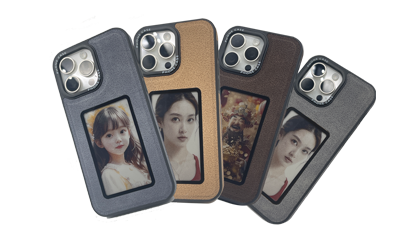
The NFC E-ink phone case is an innovative accessory combining NFC technology with an E-ink display. Simply touching it with a phone's NFC function enables battery-free wireless transmission, allowing users to project personalized images, text, and other content onto the screen for display. Applicable scenarios include business memos, travel tickets, study check-ins, etc. Practical uses can include an electronic message board, subway route map display, or vocabulary learning tool. Future potential includes smart home integration. Currently mainstream compatibility focuses on iPhone series, with Android models gradually being covered. It is affordably priced, supports customization, and combines a sense of technology with practicality.
 Download